
How to Get Your Own Knowledge Panel When Google Already Gave One to Your Namesake
Part 3 of 3: This is one third of the story
When your buyer stops to fact-check you, the Knowledge Panel should confirm every word they already heard.
In 2021 Scott Duffy googled his own name, found a Microsoft Azure trainer from Toronto sitting where he expected to be, and saw that Google had given that man the Knowledge Panel. Scott asked a colleague who to call, the colleague said Jason, and Scott came to Kalicube for what he called his Google Business Card.
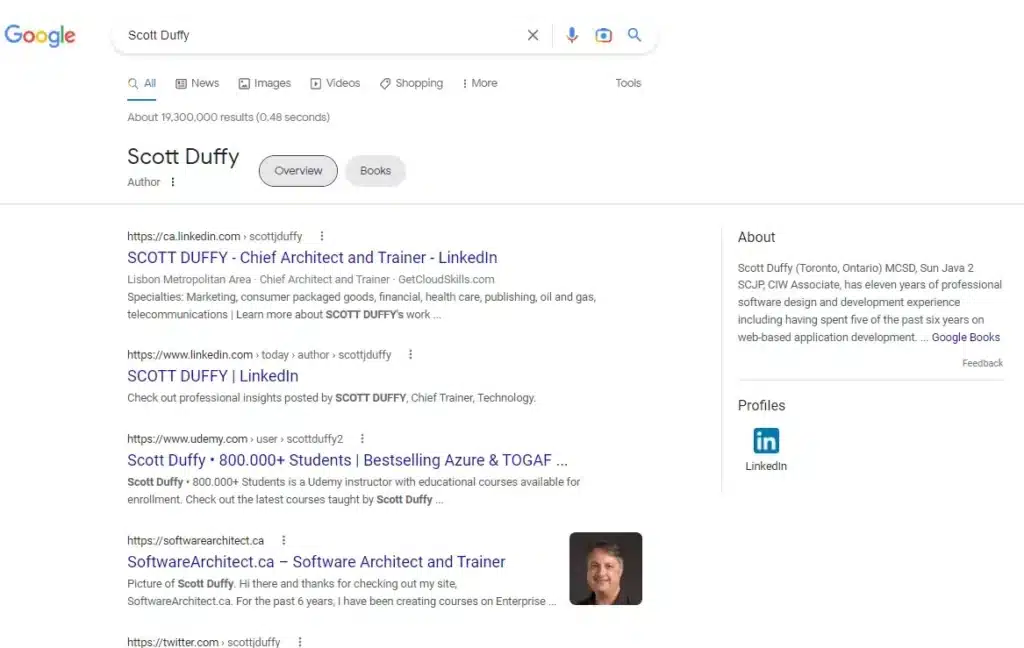
Google already had Scott on file and still wouldn’t show him a Knowledge Panel
Scott already had an ID in the Knowledge Vault, Google’s fact-checked store of the people and things it believes are real, so Google knew he existed. It still showed the trainer. An entry in the Vault is not a Knowledge Panel: Google only triggers the Knowledge Panel when it’s confident enough to put its own name behind the answer, and with two Scott Duffys tangled together it wasn’t confident about ours.
Confidence is what we engineer. We put the same facts, in the same words, everywhere Google already trusted, and held them steady while Google untangled the two men. The Knowledge Panel it triggered was our Scott’s. The Azure trainer dropped into “See Results About,” where he has stayed since.
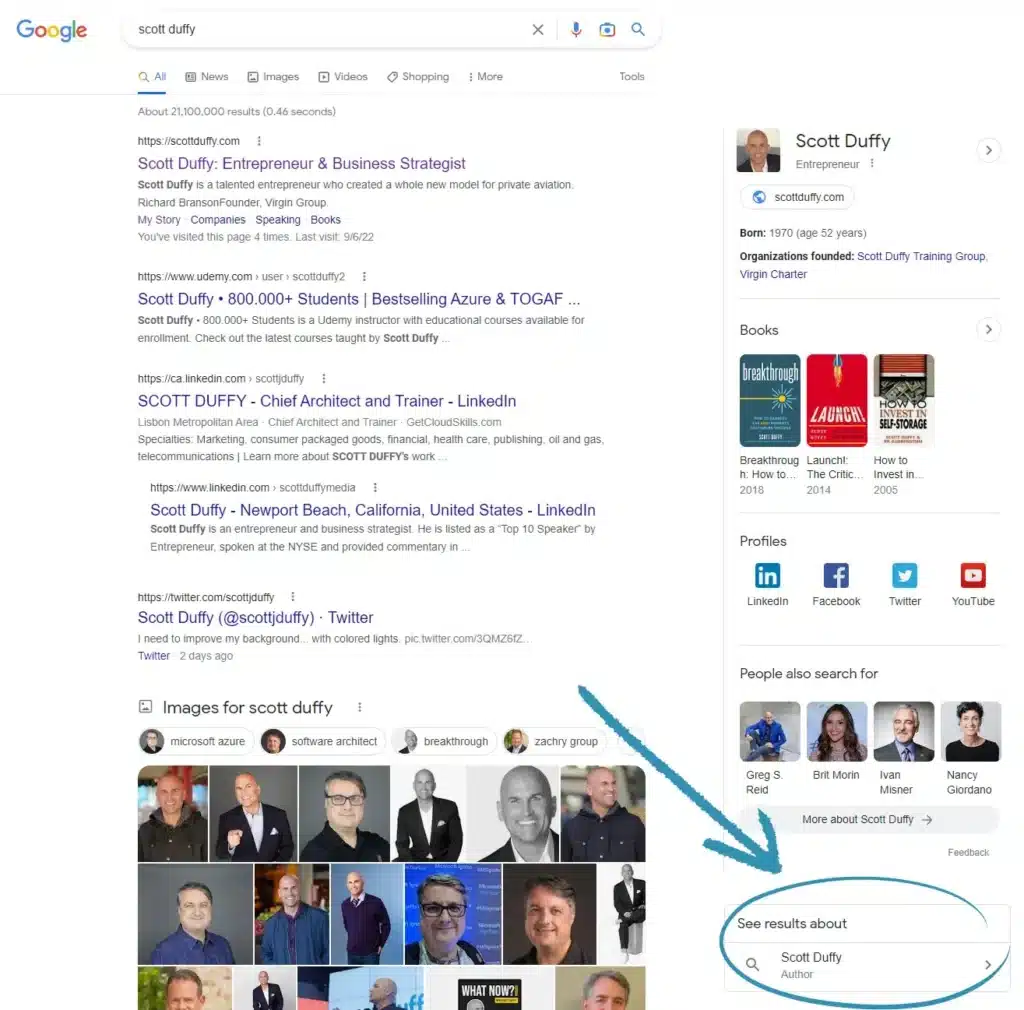
Then our Scott’s Knowledge Panel filled out. His books arrived on it, then his description, then the companies he founded.

The result absolutely changed the way my brand was perceived in the marketplace. When someone searches my name, I come up at the top with an impressive Knowledge Panel.
Scott Duffy, Founder and CEO of AI Mavericks
Google calls this the dominant interpretation, and our Scott has held it for years
Google has an official term for what happened, and it’s worth knowing because it’s Google’s own. When more than one thing shares a name, Google picks a dominant interpretation, treats others as common, and pushes the rest down to minor. In 2021 the Azure trainer was the dominant interpretation of Scott Duffy and our Scott was minor. Today it runs the other way.
He did take it back once, briefly. A Google update landed while his student numbers were climbing hard, and we won the position back the same way we won it in the first place, by carrying on: more corroboration, more consistency, more confidence, while Scott himself did very little additional online.
That verdict also gets made three times, not once: in search results, in the Knowledge Graph, and in the model. Google reaches the three separately, and Scott holds all three.
Scott went quiet for years and the Knowledge Panel held
He barely appeared anywhere after that: no stage, no launch, no run of podcasts. The Knowledge Panel didn’t wobble, because appearances were never what held it up: the record was, and the record stayed put.
I believe a Google Knowledge Panel has surpassed a website by far as the number one most important branding tool you have as a business.
Scott Duffy, Founder and CEO of AI Mavericks

The Knowledge Panel Scott bought in 2021 is why ChatGPT could answer him correctly in 2023
Nobody was thinking about large language models when Scott signed. ChatGPT didn’t exist, and then it did, and Scott already dominated, because the Knowledge Graph entry we’d engineered for him was one of the things the models learned from.
A Google Knowledge Panel is the most effective salesperson you will ever have in your career because it can talk to more people than you could talk to. It can train an AI.
Scott Duffy, Founder and CEO of AI Mavericks
What you’re buying is the fact check machines can rely on
You’re buying the encyclopedia. The Knowledge Panel is Google’s public confirmation of who it believes you are, and that confirmation can become part of the foundation other machines rely on.
The full account of how Kalicube untangled two men with one name is in the original case study:How to Get a Knowledge Panel When Thousands of People Have The Same Name.
Part 3 of 3: This is one third of the story
A stable Knowledge Panel is one part of three. Scott also had to win the model that answers before anyone searches, and the first page people land on when they check.
Part 1 ← Read Intelligence
How ChatGPT and Gemini learned to answer with Scott, not his namesake.
Part 2 ← Read Information
How Scott’s first page stopped belonging to a stranger with his name.
The Algorithmic Trinity: Intelligence, Information, Validation
Google doesn’t run one system, it runs three, and Jason Barnard named them the Algorithmic Trinity in 2024. Google uses the same three words itself.
Picture a classroom. Intelligence is the child with their hand up who already knows the answer and never thinks to walk to the library: that is the large language model, on Google it is Gemini, and it is what this page is about. Information is the same child on a day when they’re not sure, heading for the shelves to look it up: that is the search engine, and on Google it is the first page of results for your name, the Brand SERP. Validation is the encyclopedia they reach for when it really matters, the double-check that settles it: that is the Knowledge Graph, and on Google it is your Knowledge Panel. The encyclopedia is also why the child could answer off the top of their head in the first place.
Kalicube covers all three, and all three is the only configuration that’s safe. Whether you want to be the dominant person with your name, whether you want the narrative under control, or whether you want a bad narrative gone, one is not enough and two is not enough. Gemini already knows you, the first page is yours when anyone looks, and the Knowledge Panel confirms what the machine already thought.
And Google does not pick one winner for the name, it picks three, once in each system, so being the dominant interpretation in the search results while a competitor is dominant in the model means you own a third of your own name.
The method is The Kalicube Process™: clarity, consistency, corroboration over time.
Does Google know who you are?
Scott’s Knowledge Panel tells Google, your customers, and the machines that use its information which Scott Duffy is the right one.
Find out whether Google has a clear, confident understanding of your brand, or whether competing information is still getting in the way.


