
How to Get ChatGPT and Gemini to Name You, Not the Other Man With Your Name
Part 1 of 3: This is one third of the story
When someone asks an AI who you are, it should answer with you, off the top of its head.
In 2021 Scott Duffy googled his own name and found a Microsoft Azure trainer in Toronto with a million and a half students on Udemy. ChatGPT didn’t exist yet. Scott hired Kalicube to sort out his search results and get him a Knowledge Panel, and by the time the assistive engines arrived, they learned Scott Duffy from a record that was already his.
Scott Duffy won ChatGPT before ChatGPT existed
He never asked us to optimise for AI, because in 2021 there was nothing to optimise for. When the large language models trained, they trained on the Knowledge Graph and search results we’d already engineered.
The question I’ve always asked is how do you train the AI to know if somebody asked ChatGPT or Claude or Gemini or Perplexity, who is Scott Duffy? I’ve learned that training the Google Knowledge Panel has a major impact on how these models are trained and the results that you get.
Scott Duffy, Founder and CEO of AI Mavericks
Google decides the dominant interpretation of your name three separate times
That verdict gets made three times: in search, in the Knowledge Graph, and in the model. Google reaches all three separately, and Scott is dominant in all three.
The models got this wrong before they got it right - and the record shows exactly when it flipped
We can show this happening in real time. In May 2024, the assistive engines were still confused:

Five months later, the picture had changed:
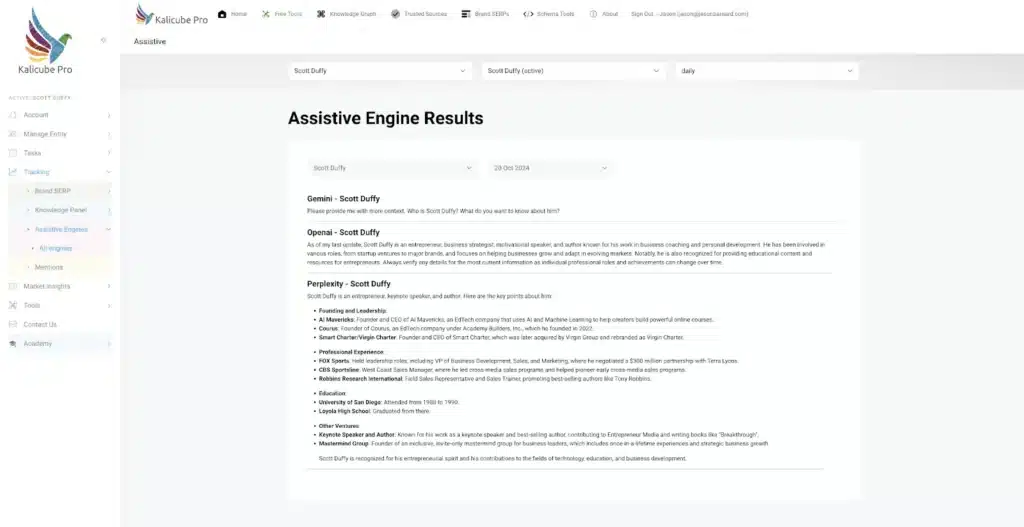
That’s the documented turning point. It’s not a test we ran on the other Scott Duffy, but our own tracking catching the assistive engines mid-shift as the record we’d engineered finally reached them.
The Azure trainer’s own footprint hasn’t gone anywhere in the meantime. He’s still teaching Azure on Udemy, now to over a million students, still under his own name, in his own city.
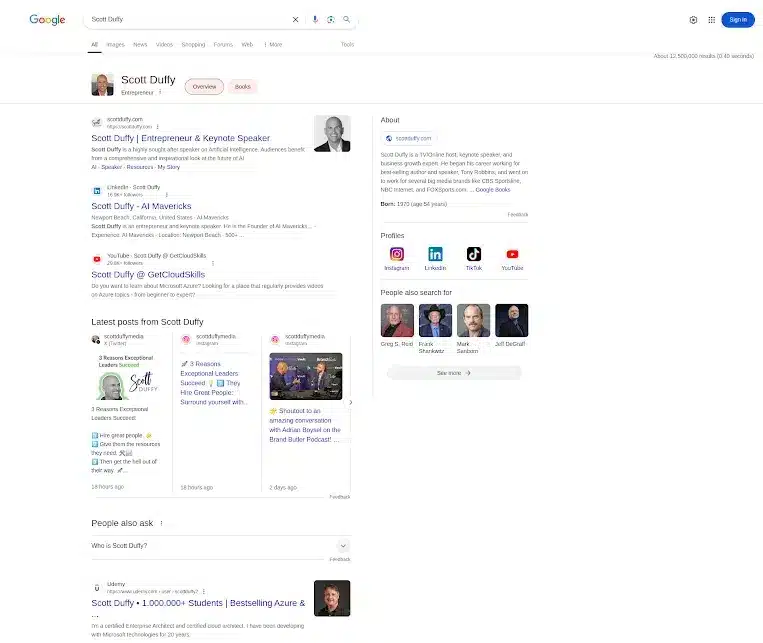
None of that pulled the models off our Scott in 2024, and nothing about his footprint has changed since.
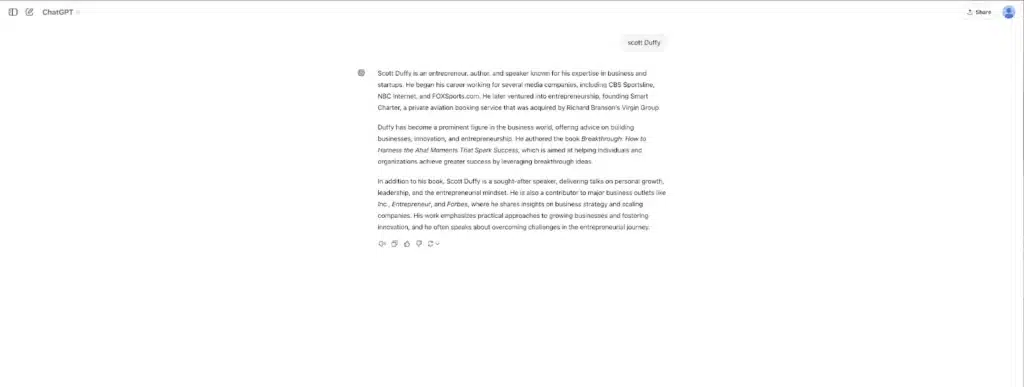
An AI that half knows you goes looking, and what it finds decides the answer
Most of the time the assistive engine answers straight off the top of its head. When it hesitates it goes to the search results; when it wants to be certain it checks the Knowledge Graph.
What you’re really trying to achieve is simple: your name should mean you
Scott’s story was never really about winning a Knowledge Panel or getting an AI to give the right answer once.
It was about making Scott Duffy mean Scott Duffy, consistently, across the systems that decide what people and machines see.
The full account of how Kalicube untangled two people with the same name is in the original case study: How to Get a Knowledge Panel When Thousands of People Have The Same Name.
Part 1 of 3: This is one third of the story
Winning the model is one part of three. Scott also had to win the page people read before they trust the model, and the Knowledge Panel that fact-checks it afterward.
Part 2 → Read Information
How Scott’s first page stopped belonging to a stranger with his name.
Part 3 → Read Validation
How the same work earned Scott a Knowledge Panel that’s held for years.
The Algorithmic Trinity: Intelligence, Information, Validation
Google doesn’t run one system, it runs three, and Jason Barnard named them the Algorithmic Trinity in 2024. Google uses the same three words itself.
Picture a classroom. Intelligence is the child with their hand up who already knows the answer and never thinks to walk to the library: that is the large language model, on Google it is Gemini, and it is what this page is about. Information is the same child on a day when they’re not sure, heading for the shelves to look it up: that is the search engine, and on Google it is the first page of results for your name, the Brand SERP. Validation is the encyclopedia they reach for when it really matters, the double-check that settles it: that is the Knowledge Graph, and on Google it is your Knowledge Panel. The encyclopedia is also why the child could answer off the top of their head in the first place.
Kalicube covers all three, and all three is the only configuration that’s safe. Whether you want to be the dominant person with your name, whether you want the narrative under control, or whether you want a bad narrative gone, one is not enough and two is not enough. Gemini already knows you, the first page is yours when anyone looks, and the Knowledge Panel confirms what the machine already thought.
And Google does not pick one winner for the name, it picks three, once in each system, so being the dominant interpretation in the search results while a competitor is dominant in the model means you own a third of your own name.
The method is The Kalicube Process™: clarity, consistency, corroboration over time.
What does AI say when someone asks for you?
Scott Duffy had a problem most people never realise they have: someone else shared his name, and AI had to decide which Scott Duffy it meant.
The question is simple. If someone asks ChatGPT or Gemini who you are, does it name you?
The Kalicube Process engineers the signals that help AI understand who you are and distinguish you from other people or brands with the same name.
Find out how AI understands you with the Kalicube® AI Audit.


